




Create and enrich the product
Product masters, variants, attributes, category and navigation hierarchies. Everything downstream inherits whatever is decided here.

Unify ERP, CRM, analytics, and cloud on one connected Microsoft platform.
Explore Solutions Industry SolutionsFind the right solution for your business
Connect Stores, E-Commerce, B2B, Call Center, Inventory and Fulfillment on One Platform
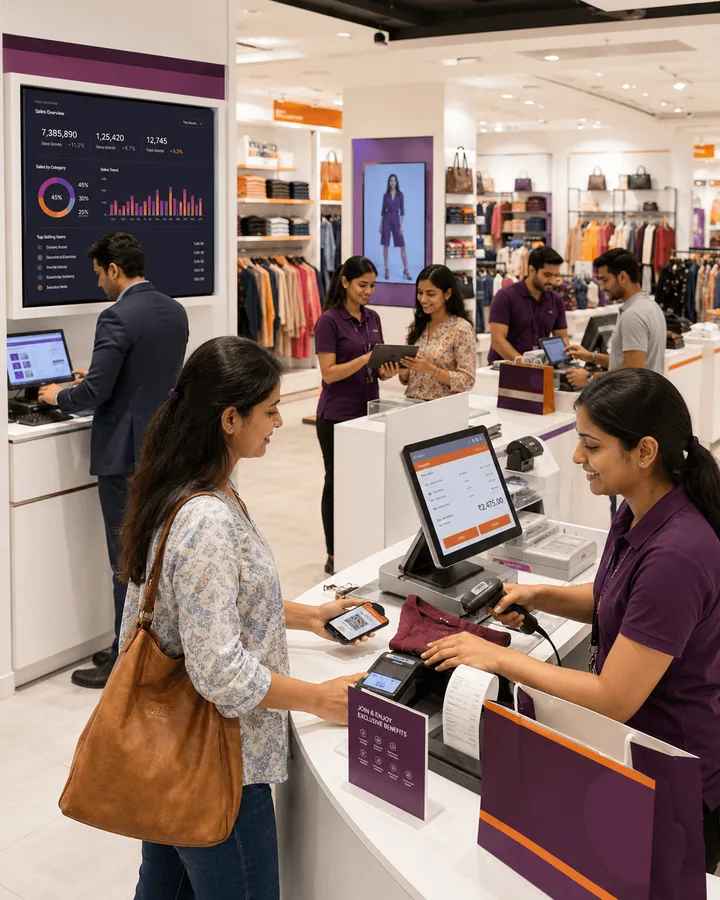
A customer never thinks “today I am an online customer” or “today I am a store customer.” They expect the right product, the correct price, honest availability, the channel they prefer, and a return that does not depend on where they bought it. Urewa Technologies helps retailers, distributors, manufacturers and multi-channel businesses implement Dynamics 365 Commerce around real customer journeys, store operations, pricing, inventory and fulfillment.
Omnichannel experience with the finance, inventory, warehouse and fulfillment foundation underneath it — because an attractive front end cannot compensate for either.
Dynamics 365 Commerce is an omnichannel retail and B2B solution covering point of sale, mobile commerce, call center, digital commerce, clienteling, merchandising, channel management, inventory visibility and order orchestration.
Its architecture is built so channels use shared commerce services and business logic rather than operating as isolated selling systems. That distinction is the whole argument — and it is what most retail estates are missing.
Thirteen stages, one platform. Select any stage to see what happens there — and where it usually breaks.
Product masters, variants, attributes, category and navigation hierarchies. Everything downstream inherits whatever is decided here.
Retail, online and call center are native Commerce channels; B2B is a distinct selling model on the same foundation. All of them share products, customers, pricing, inventory and orders.
Store Commerce is Microsoft's current point-of-sale experience, supporting cashiers, sales associates, inventory associates, stock clerks and store managers on Windows, Android and iOS.
An integrated digital-commerce platform for direct-to-consumer, B2B and wholesale, built on a responsive React front end over a scalable headless retail engine.
Call center is a native Commerce channel type. Multiple call-center channels can be defined, each with its own defaults and order-processing behaviour.
B2B e-commerce for manufacturers, distributors and wholesalers — including business-partner onboarding, account experiences and indirect B2B2B models where product moves manufacturer to distributor to business buyer.
POS design starts with the store operation, not the button layout. Before configuring anything we review store formats and size, checkout model, product categories, customer journey, peak volume, returns, exchanges, promotions, loyalty, cash management, payment methods, hardware, the warehouse relationship, pickup operations, staff responsibilities and offline requirements. A fashion store, an electronics retailer and an industrial trade counter should never receive the same POS design.
Decide what you sell, and where
Urewa principle: an assortment is a design decision, not a workaround. Flagship, small-format, airport, e-commerce and B2B should each carry a defined mix — far more controllable than hiding products store by store.
A customer visits the Pune store. The product is not available locally — but inventory exists in Mumbai and at the central warehouse.
Instead of losing the sale, the associate creates a customer order for delivery, later pickup, or pickup from another location.
This is not simply an e-commerce order. It is a connected digital and store commerce process.
Do not automatically enable every store as an e-commerce fulfillment centre. DOM can evaluate inventory, distance, cost, service level and business constraints — but the nearest store is only the right answer if it can actually deliver on the promise.
Can the store's stock figure actually be trusted?
Can employees pick orders without hurting in-store service?
Can the location prepare shipments correctly?
Can orders be dispatched efficiently from here?
Where will customer pickup orders be staged?
Can the store cope at peak as well as on a quiet Tuesday?
Can this store meet the promise made at checkout?
Commerce supports several discount structures, with concurrency rules deciding which combination applies.
20% off Product A.
Buy 3 and receive 10% off.
Buy Product A + Product B and receive a configured offer.
Spend ₹5,000 and receive ₹500 off.
Discount applies when a specified payment method is used.
Before creating promotions, answer seven questions: who qualifies, which products qualify, which channels qualify, can it combine with another offer, what happens on a return, does loyalty change the result, and which price should win. Promotion setup must be designed together with return and exchange scenarios — because selling is simple, and correctly reversing a complex promotion is not.
Challenge80 stores and an e-commerce site running separate inventory and different promotions. Customers cannot return online purchases in store.
ApproachCentral products, assortments and unified pricing behind Store Commerce and e-commerce, with Inventory Visibility, store pickup and cross-channel returns.
OutcomeA consistent omnichannel experience instead of two businesses sharing a logo.
ChallengeA customer wants a laptop model the store does not hold.
ApproachProduct search, cross-store inventory lookup, then a customer order fulfilled from the warehouse with home delivery.
OutcomeThe associate keeps the sale without local stock.
ChallengeDealers order by email, with different catalogues, pricing, quantities, accounts and delivery addresses.
ApproachAccount sign-in, applicable catalogue, business pricing, bulk ordering and invoice or balance visibility.
OutcomeLess manual order entry and genuine customer self-service.
ChallengeThree brands, four legal entities, 150 stores and two e-commerce sites needing shared visibility but separate brand pricing.
ApproachCommerce channels, price groups, assortments, legal-entity ownership and DOM designed around the group's operating model.
OutcomeCentral merchandising with brand and entity control intact.
ChallengeThe central warehouse is overloaded at peak while stores hold available stock.
ApproachDOM selects a nearby store, which receives, picks, packs and ships the order.
OutcomeDistributed inventory and capacity used properly instead of sitting idle.
ChallengeA customer phones the sales centre rather than ordering online.
ApproachAgent creates the order, customer selects local pickup, store prepares it, customer collects.
OutcomeProof that call center belongs in commerce, not just customer service.
We design store, digital, B2B, call center, inventory, fulfillment and finance as one operating model — not a till with a website attached.
Commerce depends on product, inventory, warehouse, cost, tax, procurement and fulfillment. Our Finance and Supply Chain experience means we design the whole process, not only the storefront.
We analyse the customer journey across channels before configuring any individual application.
Base, channel and customer pricing, promotions, loyalty, discount concurrency, override policy and return behaviour — defined before mass configuration.
Inventory and fulfillment design has to support whatever the customer-facing channel is promising. Otherwise technology creates a service problem rather than solving one.
Standard Commerce, then configuration, then Power Platform, then integration, then extensions — and custom headless development last.
We design around cashiers, associates, store managers, inventory staff, e-commerce and call-center teams and merchandising — not only IT administrators.
Retail UAT covers mixed promotions, partial payment, failed payment, partial pickup, offline, cross-store orders and statement posting. An implementation is not done because a POS invoice posted.
Do your stores and e-commerce site use the same product information?
Are prices and promotions managed centrally?
Can customers see accurate inventory before placing an order?
Can store associates check inventory across other locations?
Can a customer buy online and pick up in store?
Can a store fulfill an online order?
Can online purchases be returned through physical stores according to policy?
Does loyalty work consistently across channels?
Can store associates see relevant customer history?
Can an out-of-stock store still create a customer order from another location?
Can B2B customers place and review orders digitally?
Can the business determine the best fulfillment location automatically where required?
Do store transactions reconcile accurately into Finance?
Can management analyse store and digital performance consistently?
Are POS, e-commerce, inventory and ERP tightly connected?
Answer all fifteen questions to see your result (0/15 answered).
Stores, POS, digital commerce, loyalty and omnichannel fulfillment.
Variants, promotions, loyalty, clienteling and omnichannel inventory.
Product discovery, inventory visibility, endless aisle, pickup and delivery.
Store sales, product ranges, pricing, promotions and customer engagement.
B2B commerce, customer-specific pricing, inventory and order management.
Direct-to-consumer, dealer commerce and B2B digital channels.
Large product ranges, B2B ordering, trade-counter selling and distributed inventory.
Shared commerce architecture with controlled channel, brand and legal-entity structures.
Business Central provides broad business management across finance, purchasing, inventory, sales, manufacturing and projects.
Commerce adds deeper enterprise commerce — Store Commerce, e-commerce, omnichannel, retail pricing, promotions, loyalty, B2B, call center, store fulfillment, DOM and Commerce Scale Unit.
Supply Chain Management covers procurement, inventory, warehousing, planning, manufacturing, logistics and operational fulfillment.
Commerce covers the customer-facing side — stores, POS, digital commerce, pricing, promotions, loyalty, order capture and omnichannel experiences. Most enterprise retail needs both.
Sales focuses on leads, accounts, opportunities, relationship selling, pipeline and forecasting.
Commerce focuses on transactional selling — product, POS, digital and B2B ordering, pricing, checkout, payment and fulfillment. A business with both complex relationship selling and high transaction volume may use each.
An omnichannel retail and B2B platform that connects physical stores, point of sale, digital commerce, call center, products, pricing, promotions, customers, inventory and order fulfillment through shared commerce services.
No. It includes a modern POS application called Store Commerce, but Commerce is broader — e-commerce, B2B, call center, pricing, promotions, loyalty, clienteling, inventory, orders, fulfillment and headless commerce.
Store Commerce is Microsoft's current point-of-sale application for Dynamics 365 Commerce. It supports sales, customer engagement, inventory, fulfillment, assisted selling and store operations across supported Windows and mobile platforms.
Yes. Store Commerce supports offline operation when the appropriate offline architecture is configured. Microsoft also provides self-hosted Commerce Scale Unit options for stores where connectivity to headquarters may be unreliable.
Yes. Commerce supports store-pickup scenarios through its online and POS order-management capabilities, including pickup at a different store from the one the order was raised in.
Yes. Store order-fulfillment capabilities let store users accept assigned orders, pick, ship, prepare for pickup and complete pickup — turning stores into fulfillment nodes.
DOM helps determine appropriate fulfillment locations based on available inventory, location, customer destination, distance, cost, service-level requirements and defined business constraints, using optimisation techniques rather than fixed rules.
Commerce integrates with Microsoft's Inventory Visibility service to support near-real-time inventory queries, reservations and adjustments across relevant commerce scenarios, including cross-store and cross-company lookup.
Commerce Scale Unit hosts the headless commerce engine, Commerce Runtime and channel database used by Commerce channels. Headless commerce separates the customer-facing experience from the business logic, exposing products, customers, prices, inventory and orders through APIs so custom storefronts and apps can use them.
Yes — business accounts and users, account-management experiences, order templates, bulk ordering, quick product entry, customer balance and invoices, plus indirect B2B2B models where product moves from manufacturer through distributor to business buyer.
Yes, depending on the process. Microsoft has expanded cross-company inventory visibility and, in its 2026 release, cross-legal-entity DOM fulfillment with automated intercompany order flows. The deployed version and enabled features should be validated before relying on this in production.
Microsoft provides Copilot-based insights in Store Commerce for customer, product and store-report scenarios. Agentic commerce through Commerce MCP is also in development, but Microsoft currently labels it preview — it should not be planned as a production capability until that changes.
Microsoft lists Dynamics 365 Commerce, the e-Commerce add-on and the headless add-on as separate commercial offerings. Licensing should be verified against Microsoft's current licensing guide for your country and deployment before budgeting.
Often yes. Because Commerce has a headless API architecture, you can keep a custom or third-party storefront while using Commerce as the business-logic platform for products, pricing, inventory and orders. The right architecture depends on your existing applications and integration requirements.
Yes. We assess Store Commerce, POS, e-commerce, products, assortments, pricing, promotions, loyalty, inventory, orders, fulfillment, payments, statements, integrations, extensions, Commerce Scale Unit and performance, then produce a prioritised improvement roadmap.
Procurement, inventory, warehousing and fulfillment — the operational execution behind every customer order.
Explore Supply Chain →Retail financeWhere statements, tender, tax, cost and customer balances are reconciled after the store closes.
Explore Finance →Simpler estatesBroad business management for organisations whose channel requirements do not need enterprise commerce.
Explore Business Central →Connecting commerce to payment providers, marketplaces and portals is covered in our ERP integration guide. Project-based businesses should also look at Project Operations. Microsoft documents the product itself on Microsoft Learn.
Separate POS and online platforms, inconsistent pricing, promotion complexity, poor inventory visibility, lost sales because a product is not in this store, B2B orders arriving by email, duplicate customer records, difficult returns, payment reconciliation — these are the symptoms. We design the architecture that removes them, from product and pricing through stores, e-commerce, B2B, inventory, fulfillment and Finance.