







How Dynamics 365 Supply Chain Management Improves Inventory Visibility and Operational Efficiency
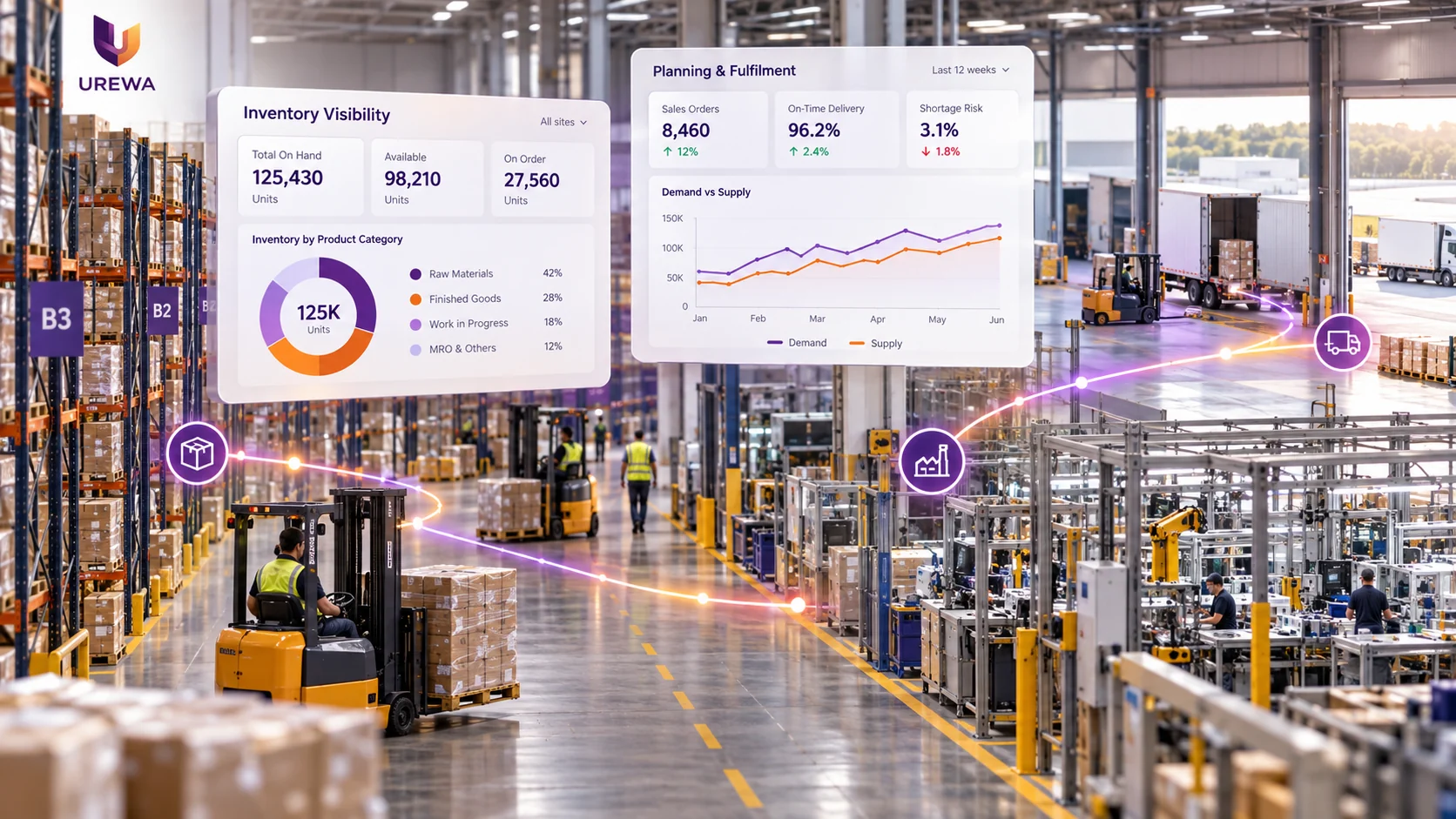
A thousand units in stock does not mean a thousand units you can promise. Four hundred may be reserved, two hundred under inspection and a hundred allocated to another channel. Visibility is knowing the difference — before you answer the customer.
- Supply Chain
- Urewa Editorial
- Practical guide
- 13 min read
- 2026
Contents
Modern supply chains depend on accurate information and fast coordination across sales, planning, procurement, inventory, manufacturing, warehousing and logistics. When those functions run on disconnected systems or spreadsheets, the symptoms are familiar: inaccurate inventory, late purchasing, production shortages, excess stock and no clear view of what can actually be fulfilled.
Microsoft Dynamics 365 Supply Chain Management brings these activities into a connected environment so teams work from a clearer view of demand, supply, inventory and operational priority. The value is not another ERP system. It comes from connecting the complete flow:
Demand → Planning → Procurement and manufacturing → Inventory → Warehouse → Fulfilment → Customer
01DefinitionWhat is Dynamics 365 Supply Chain Management?
Dynamics 365 Supply Chain Management supports the core supply-chain processes:
- Inventory management
- Procurement and sourcing
- Demand and supply planning
- Manufacturing
- Warehouse management
- Transportation and logistics
- Asset management
- Order fulfilment
The objective is a common operational platform rather than each process managed independently. That becomes particularly useful for organisations running multiple warehouses, suppliers, plants, products or distribution channels — where the cost of inconsistent information multiplies with every additional site.
02The Core ProblemBetter inventory visibility
Inventory visibility is more than knowing total stock. A business needs to answer:
- What is physically available?
- What has already been reserved?
- What is arriving from suppliers?
- What is in transit?
- Which warehouse holds the stock?
- Which customer demand is competing for it?
Take a company holding 1,000 units. Four hundred may already be reserved, two hundred may be under quality inspection and another hundred allocated to a different sales channel. The headline number says 1,000. The answerable number is 300.
The real question is never “how much stock do we have?” It is “how much can we actually promise?”
Dynamics 365 lets organisations see stock movements and inventory positions across locations, so sales, procurement, warehouse and planning teams work from consistent information. That is what reduces stockouts, excess inventory and unnecessary purchasing — not the counting, but the agreement on what the count means.
Microsoft also ships a dedicated Inventory Visibility add-in for exactly this problem: a separate service that tracks on-hand, ordered, purchased, in-transit, returned and quarantined stock across data sources, warehouses and locations, with real-time queries, soft reservations to prevent overselling across channels, and available-to-promise dates for order promising. It is included with a Supply Chain Management licence, and external systems can read it over REST APIs — which matters if your webshop or third-party logistics provider needs the same answer your sales team has.
03PlanningDemand and supply planning
Planning connects customer demand with available and future supply. Demand arrives as sales orders, forecasts, seasonal trends, promotions and customer commitments. Supply comes from current inventory, purchase orders, production and transfers between warehouses.
Consider demand rising to 5,000 units. Before anyone raises a purchase order, the planner can see what already exists:
| Quantity | Source |
|---|---|
| 2,800 units | In stock and available now |
| 500 units | On an incoming purchase order |
| 700 units | Available in another warehouse |
| 1,000 units | Can be produced in time |
The total already covers the demand. A planner working from one isolated shortage message would have bought stock the business already owned. That is the difference connected planning makes — a supply decision taken against the complete operational picture.
The calculation behind that view now runs on Planning Optimization, which moves master planning out of the application database into a scalable external service. Microsoft has made it the standard master planning engine and requires it for new cloud deployments, so an organisation still running the deprecated engine should treat migration as a planned piece of work rather than a surprise.
04SourcingSmarter procurement
Procurement should not operate separately from planning and inventory. A buyer needs visibility of current inventory, planned demand, open purchase orders, supplier delivery dates, shortages and supplier performance.
Procure-to-pay, connected
- 01PlanningRequirement identified against real demand and supply
- 02ProcurementPurchase requisition raised
- 03ApprovalAuthorised within the delegated limit
- 04ProcurementPurchase order issued to the supplier
- 05SupplierOrder confirmed with a committed date
- 06WarehouseGoods received against the order
- 07FinanceInvoice matched and posted
Connecting these activities means procurement understands not only what to buy, but why and when it is needed. Supplier performance can then be evaluated on more than price:
- On-time delivery
- Lead time
- Quality
- Purchase-price variance
- Open and overdue orders
The cheapest supplier who delivers late to a production line is not the cheapest supplier.
05FulfilmentWarehouse management and fulfilment
Warehouse operations decide whether available inventory actually reaches the customer efficiently. The process chain runs receiving, put-away, replenishment, picking, packing, staging and shipping.
A business may technically hold enough inventory to fulfil an order while that stock sits in reserve storage, is allocated to another order, is under quality control or is in a different warehouse entirely. Warehouse visibility is what tells operations the difference between stock that exists and stock that can be picked today.
For multi-site organisations this matters more, not less. Stock in the wrong warehouse is a fulfilment problem wearing an inventory problem’s clothes.
Microsoft’s warehouse management documentation describes a configurable capability set covering manufacturing, distribution and retail warehouses, integrated with transportation, manufacturing, quality control, purchasing, transfers, sales and returns. There is also a warehouse-only mode, where a dedicated legal entity runs the warehouse capabilities and integrates with other entities or external systems — useful when a third-party logistics operation sits inside a wider group.
06ProductionManufacturing visibility
Manufacturing businesses need production plans connected to material availability. A production order cannot be completed simply because demand exists — it needs raw materials, BOM availability, routing, capacity, warehouse availability and a schedule.
Take a production order scheduled for Monday. Most components are available, but one critical material is short. The business needs to know that before the order reaches the shop floor, because the alternatives are only useful in advance:
- Expedite the supplier
- Transfer stock from another warehouse
- Reschedule production
- Use another approved supply source
Visibility that arrives after the event is reporting. Visibility that arrives before it is operational control.
07ResponseResponding to supply chain disruptions
No system eliminates disruption. Suppliers run late, demand moves, transport is delayed, warehouses overload. What connected information changes is how quickly the business understands the impact.
Supplier delay
Assess the impacted production orders, available stock, alternative suppliers, inventory in other warehouses and the customer orders at risk — then decide.
Demand spike
Check available stock, incoming supply, transfer possibilities and manufacturing capacity before committing to a date.
Inventory shortage
Before buying more material, determine whether excess already exists at another warehouse. Buying stock you already own is the most expensive kind of invisible inventory.
08MeasurementAnalytics and supply chain KPIs
Once supply-chain information is connected, performance becomes measurable rather than anecdotal.
| Area | Example KPIs |
|---|---|
| Inventory | Stock accuracy, inventory turns, ageing, stockouts |
| Procurement | Supplier on-time delivery, lead time, PO cycle time |
| Warehouse | Picking accuracy, receiving time, order cycle time |
| Manufacturing | Plan versus actual, scrap, production efficiency |
| Customer | Fill rate, backorders, on-time delivery |
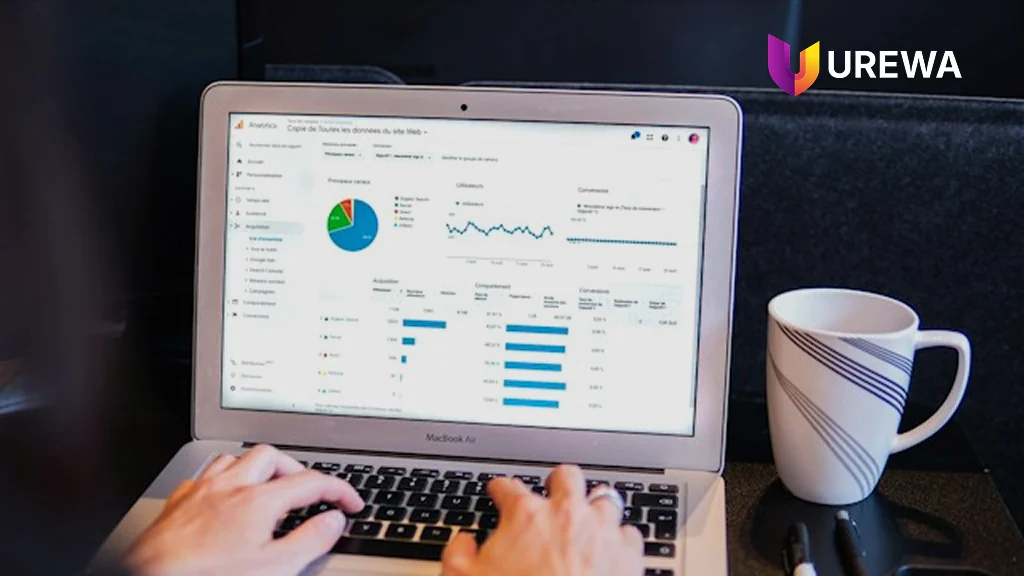
Dashboards help managers find where attention is required instead of manually reviewing several spreadsheets. If you are interested in which reporting technology suits which requirement, we covered that in detail in Power BI vs Excel for Dynamics 365 reporting.
09Decision SupportAI and Copilot in supply chain planning
AI is becoming another layer of supply-chain decision support. In planning scenarios, AI-assisted capabilities help users identify unusual demand patterns, forecast changes, exceptions, trends and areas requiring attention.
AI does not replace the planner. It helps the planner reach the exceptions that need human judgement faster.
Across large datasets, that reduces the time needed to identify risk — which in a supply chain is usually the whole game.
10Worked ExampleOne end-to-end example
Consider a customer ordering 5,000 units, and follow it through every function that touches it:
- 01SalesCustomer demand for 5,000 units is recorded.
- 02PlanningA shortage against available supply is identified.
- 03InventoryAvailable stock is reviewed across every warehouse.
- 04ProcurementIncoming purchase orders and supplier dates are checked.
- 05ManufacturingAdditional production is planned for the remaining gap.
- 06WarehouseInventory is transferred, picked and packed.
- 07FulfilmentGoods are shipped to the customer.
- 08ManagementOrder, inventory and supply status stay visible throughout.
That is what supply-chain visibility actually means: different teams working with the impact of the same business event, rather than each discovering it separately and late.
11Master DataTechnology alone is not enough
Dynamics 365 provides sophisticated supply-chain capability, but results still depend on business foundations. Reliable data is needed for:
- Product master data
- Vendor information
- Lead times
- Planning parameters
- BOMs and routes
- Warehouse setup
- Inventory policies
Poor data produces poor planning regardless of how advanced the technology is. Wrong lead times and incomplete BOMs will defeat any planning engine ever written.
Organisations should also avoid unnecessary customisation. The order that works is standard functionality first, configuration second, and customisation only where genuine business value justifies it — a discipline we cover in full on our Dynamics 365 implementation services page.
12MethodUrewa's approach
At Urewa we approach Supply Chain Management as a business-process transformation rather than an ERP installation.
| Stage | What happens |
|---|---|
| Process assessment | Understand the current planning, inventory, procurement, manufacturing and warehouse processes before configuring anything. |
| Fit-to-standard | Use Dynamics 365 standard capability wherever it is practical, and justify every departure from it. |
| Master-data readiness | Establish reliable product, inventory, vendor and planning information — the input that decides whether planning output is trustworthy. |
| End-to-end validation | Test complete flows from demand through supply and fulfilment, including the exceptions, rather than testing modules in isolation. |
| Operational measurement | Define the KPIs that will show whether the implementation actually improved performance. |
The objective is not to implement every feature available in Dynamics 365. It is to improve visibility, control and operational decision-making — and to be able to show, with numbers, that it worked.
Conclusion
Effective supply chains depend on connected information. Dynamics 365 Supply Chain Management connects demand, planning, procurement, inventory, manufacturing, warehouse operations and fulfilment, giving better visibility of current conditions and a faster response when supply or demand moves.
For organisations managing complex inventory, multiple warehouses, manufacturing or growing supply-chain requirements, it provides a platform for more structured and scalable operations. The real value is not automation. It is different teams making better decisions from the same operational information.
13QuestionsFrequently asked questions
What is Dynamics 365 Supply Chain Management?
Microsoft Dynamics 365 Supply Chain Management supports core supply-chain processes including demand and supply planning, procurement and sourcing, inventory management, manufacturing, warehouse management, transportation, asset management and order fulfilment — on one platform rather than as separate systems.
How does Dynamics 365 improve inventory visibility?
It connects inventory information across locations and business processes, so sales, planning, procurement and warehouse teams work from the same picture of what is on hand, what is reserved, what is inbound and what can actually be promised to a customer.
Can Dynamics 365 support multiple warehouses?
Yes. Inventory and warehouse processes run across multiple sites, warehouses and locations, which is where visibility matters most — stock sitting in the wrong warehouse is a fulfilment problem, not an inventory problem.
Can Dynamics 365 help with manufacturing?
Yes. Production can be connected with planning, material availability, inventory and warehouse operations, so a shortage on a critical component surfaces before the production order reaches the shop floor rather than after.
Can Dynamics 365 help manage supply-chain disruptions?
It cannot prevent disruption. What connected inventory, supply, demand and operational information does is let the business assess the impact and evaluate the alternatives faster — expedite, transfer, reschedule or re-source.
Does Dynamics 365 support AI in supply-chain planning?
Microsoft continues to introduce AI-assisted capabilities across Dynamics 365, including planning scenarios where AI helps identify trends, anomalies and exceptions. The useful framing is that it helps planners reach the exceptions faster, not that it replaces planner judgement.
How long does a Supply Chain Management implementation take?
It depends on the number of sites and warehouses, process complexity, manufacturing mode, integrations and — most of all — the state of master data. A credible timeline comes out of a process assessment, not from a feature list.
What causes supply-chain implementations to underperform?
Usually master data rather than software. Inaccurate lead times, incomplete BOMs, wrong planning parameters and unmaintained item setup will produce poor planning output regardless of how capable the platform is.
Should we customise Dynamics 365 for our supply chain?
Standard functionality first, configuration second, customisation only where genuine business value justifies it. Supply-chain customisation is particularly expensive to maintain because it tends to sit across planning, inventory and warehouse logic simultaneously.
Planning a Dynamics 365 Supply Chain Transformation?
If your operation still depends on spreadsheets, disconnected inventory information or manual supply-chain processes, we can identify where Dynamics 365 creates measurable operational improvement — across Supply Chain Management, inventory and warehousing, procurement, planning, manufacturing, master data, Power BI and integrations.
Or email us directly: info@urewa.com