







ERP Implementation Services in India: What Should Actually Be Included?
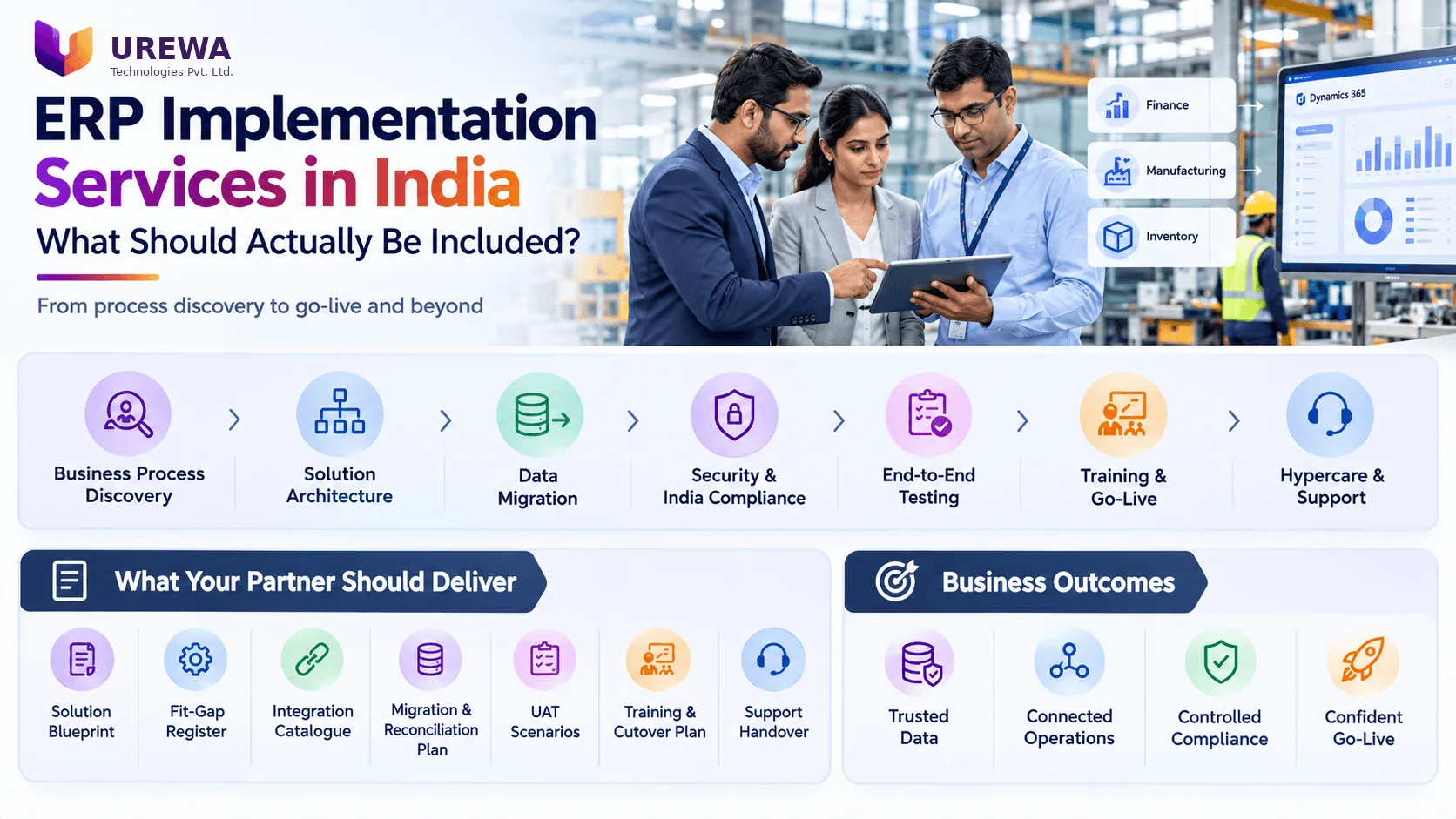
An ERP project should not be judged only by whether it goes live on schedule. This guide sets out what a serious Dynamics 365 implementation should deliver before you are asked to go live: process, architecture, data, compliance, testing, cutover and support.
- ERP Implementation
- Abhishek Divekar
- Buyer’s guide
- 10 min read
- 2026
Contents
A system can technically be live while:
- finance still reconciles in Excel
- planners work outside the ERP
- integrations fail silently
- users do not trust the data
- and every new requirement becomes another customization
The implementation is often won or lost months before go-live, through process design, architecture, data preparation, testing and cutover planning. So when you evaluate ERP implementation services in India, the real question is not “Can this partner implement Dynamics 365?” It is:
What exactly will they deliver before asking us to go live?
Microsoft’s own implementation guidance emphasizes discovery, solution design, implementation, testing, readiness and stabilization across the lifecycle. For a serious Dynamics 365 ERP implementation, these seven areas should be clearly included. If you want the full delivery method behind them, read our practical Dynamics 365 delivery approach.
01Start Here1. Business process discovery before configuration
A good implementation does not begin by demonstrating screens. It begins by understanding how the business actually operates, across processes such as:
- Order-to-cash
- Procure-to-pay
- Inventory
- Manufacturing
- Warehouse operations
- Projects
- Banking
- Financial close
- Reporting
The objective is to define the future business process, not to recreate the old ERP in Dynamics 365. Every important requirement should then be classified as one of:
- Standard functionality
- Configuration
- Process change
- Integration
- Reporting
- Genuine extension
Customization should be used where it creates clear business value, not as the default answer. Our guide to ERP modernization explains how to decide what to retain, replace, redesign or retire.
02Systems2. Solution architecture
ERP rarely operates alone. A Dynamics 365 implementation may need to work with banks, payroll, CRM, e-commerce platforms, logistics providers, manufacturing systems, tax services, Power Platform, Power BI and other applications. The implementation partner should clearly define:
- Which system owns which data?
- How will information move between systems?
- What happens when an integration fails?
- Who monitors and supports it?
An API working during a demo does not mean the integration is finished. A production integration also needs monitoring, error handling, reconciliation and ownership. Our guide to ERP integration with Dynamics 365 covers how to decide what is real time, what is batch and who owns each data set.
03Ownership3. Data migration with business ownership
Data migration should start early. A project should decide what actually needs to move:
- Master data
- Open transactions
- Opening balances
- Selected historical data
- Supporting reference information
Before migration, data needs to be cleaned and mapped, and there should be multiple trial migrations before production cutover. Most importantly, IT can move the data, but the business must approve the data. A technically successful upload does not mean the migration is correct.
| Team | What they confirm |
|---|---|
| Finance | Reconciles balances |
| Procurement | Validates vendors and open purchase orders |
| Sales | Verifies customers and open orders |
| Inventory | Validates stock |
The test is not “Did the file load?” It is “Can the business trust and operate with this data?” We cover this in depth in our ERP data migration guide.
04Controls4. Security, controls and India compliance
Security and compliance should be part of the design, not activities added just before go-live. The project should define:
- roles
- approval authority
- segregation of duties
- company access
- and sensitive transactions
For Indian entities, the solution design also needs to consider applicable requirements such as GST, TDS/TCS, e-invoicing and other statutory processes supported through Dynamics 365 localization. Microsoft documents, for example, how Finance supports electronic invoices in India through registration with the Invoice Registration Portal.
Compliance should be tested as part of the actual business process. A sales transaction should not stop at “Invoice posted successfully.” The implementation should confirm that inventory, tax, receivables, revenue, cost and the general ledger all reflect the transaction correctly. If finance has to re-key tax information or maintain separate spreadsheets to understand what the ERP posted, the implementation may be live, but it is not finished.
05Proof5. End-to-end testing
Testing individual screens is not enough. Users should test complete business scenarios using realistic data, for example:
Order-to-cash
- 01SalesSales order.
- 02InventoryInventory reservation.
- 03DispatchDispatch.
- 04ComplianceApplicable GST and e-invoice process.
- 05BillingCustomer invoice.
- 06FinanceAccounting.
- 07CashCustomer receipt.
- 08CloseSettlement.
Procure-to-pay
- 01RequestPurchase requisition.
- 02ApprovalApproval.
- 03OrderPurchase order.
- 04ReceiptGoods receipt.
- 05InvoiceVendor invoice.
- 06TaxGST and TDS treatment.
- 07MatchingThree-way matching.
- 08PaymentPayment, settlement and accounting.
For manufacturing companies, testing should also connect planning, material availability, production, consumption, finished goods and costing. Exceptions are equally important. Test these before go-live, not after it:
- Returns
- Partial receipts
- Credit notes
- Rejected workflows
- Integration failures
- Reversals
06Readiness6. Training, cutover and go-live readiness
Training should follow the employee’s actual job.
| Role | What they need to learn |
|---|---|
| Buyer | Create and manage a purchase order correctly, not fifty menus. |
| Warehouse user | Receive, move and issue inventory. |
| Finance | How transactions reconcile and how month-end works. |
The project should also have a rehearsed cutover covering:
- data freeze
- final migration
- configuration deployment
- integrations
- user access
- opening balances
- reconciliation
- smoke testing
- and business sign-off
Microsoft’s Success by Design guidance treats a cutover plan, practising it in a test environment as a mock cutover or dress rehearsal, and a go/no-go decision as part of go-live preparation. Its go-live checklist adds support readiness.
07After Go-Live7. Hypercare and support
Go-live is the beginning of production operations, not the end of implementation. The first few weeks should follow a defined hypercare model covering:
- critical issue resolution
- integration monitoring
- reconciliation
- user support
- data corrections
- and the first important operational cycles
For Finance implementations, the first month-end close is particularly important. The implementation team should help the business confirm that transactions, reconciliations and reporting work under real operating conditions.
08DeliverablesWhat should you actually receive from the implementation partner?
Before signing the proposal, check whether the scope includes tangible deliverables:
| Deliverable | What it should answer |
|---|---|
| Solution blueprint and future-state process design | What the business will actually run, and what changes. |
| Fit-gap and customization register | Which requirements are standard, configured, extended or changed. |
| Configuration and security design | Who can do what, and how the system is set up. |
| Integration catalogue | Every interface, its owner, monitoring and error handling. |
| Data migration strategy and reconciliation approach | What moves, who approves it and how it is proven. |
| Test strategy and UAT scenarios | The end-to-end scenarios that must pass before go-live. |
| Training plan | Role-based training for each group of users. |
| Cutover and go-live plan | Tasks, owners, timing, validation and the go/no-go criteria. |
| Hypercare and support handover | Who supports the business after go-live, and how. |
If the proposal jumps from “Kick-off” directly to “Go-Live”, ask what happens in between and who signs it off.
09Delivery ModelSpecialist partner, global SI or staff augmentation?
There is no universally correct delivery model.
| Model | Where it fits | Watch for |
|---|---|---|
| Global systems integrator | A large international transformation that needs scale. | Senior access and a leaner structure may be harder to get. |
| Specialist Dynamics partner | Direct access to senior consultants and a leaner delivery structure. | Check capacity against the size of your programme. |
| Staff augmentation | Customers with strong internal architecture, governance and project management. | You carry the delivery risk and the design accountability. |
The more important question is: who exactly will work on your project? The company logo on the proposal matters less than the experience, availability and accountability of the people named in the delivery team.
10ChecklistQuestions to ask before signing
Instead of only asking how many years the partner has been in business, ask:
- Who exactly will be assigned to my project?
- Which requirements will use standard Dynamics 365 functionality and which require customization?
- Who owns data cleansing and reconciliation?
- How will integrations be monitored after go-live?
- How will GST and other local statutory requirements be tested?
- Which end-to-end scenarios must pass before go-live?
- Who supports us during the first month-end close?
The quality of those answers usually tells you more than a long company presentation.
11RisksWhere ERP implementations usually go wrong
ERP projects rarely fail because somebody could not configure a screen. More often, problems begin when:
- data ownership is unclear
- process decisions remain unresolved
- every legacy customization is rebuilt
- integrations are tested too late
- compliance is treated as an afterthought
- users only test ideal scenarios
- or cutover is treated as a weekend activity rather than a business transition
A good implementation partner should identify these risks early and make them visible.
12UrewaReady to plan your Dynamics 365 implementation?
A good implementation starts before anybody configures the software. At Urewa Technologies, our Dynamics 365 implementation services begin with the business process, architecture, data, integrations, controls and expected outcomes. If you are evaluating a new implementation, bring us one of your most difficult processes. The one that depends on spreadsheets, manual reconciliation, repeated approvals or disconnected applications is usually the best place to start.
Already live but struggling with processes, controls, integrations or reporting? An ERP audit and health check can help identify where the implementation needs improvement, and our team can talk it through. You can also compare Dynamics 365 Finance, Supply Chain Management and Business Central for your size and complexity.
13QuestionsFrequently asked questions
What should ERP implementation services in India include?
A complete scope should include business process discovery, solution architecture, data migration with business reconciliation, security and India compliance design, end-to-end testing, training, a rehearsed cutover, and hypercare after go-live, each with a named deliverable and a business sign-off.
How long does a Dynamics 365 ERP implementation take?
There is no responsible timeline without understanding the scope. A focused implementation may be completed within a few months, while multi-entity, manufacturing or highly integrated programs can take considerably longer. Applications, countries, legal entities, data quality, integrations, customization and the speed of business decisions all affect the timeline.
What are the biggest ERP data migration risks?
Common risks include duplicate or inaccurate master data, incorrect opening balances, incomplete open transactions and unclear ownership of historical data. Migration should include cleansing, trial loads and business reconciliation before production cutover.
How should Indian and overseas entities be handled?
A global solution should define what is common across the organization and what needs to remain local. Indian entities may require India-specific tax and statutory processes, while overseas entities need their own localization and compliance requirements. The goal is a controlled global template without forcing every country into an identical operating model.
Should every legacy process be recreated in Dynamics 365?
No. One of the biggest benefits of a new ERP implementation is the opportunity to simplify processes and remove unnecessary technical debt. The right question is not how to rebuild a customization, but whether the customization is still needed.
Who should approve migrated data?
The business. IT can move the data, but finance, procurement, sales and inventory teams must reconcile and approve it. A file that loads successfully is not the same as data the business can trust and operate with.
Evaluating an ERP Implementation Partner?
Bring us one of your most difficult processes. We will show you what a Dynamics 365 implementation should deliver before go-live.